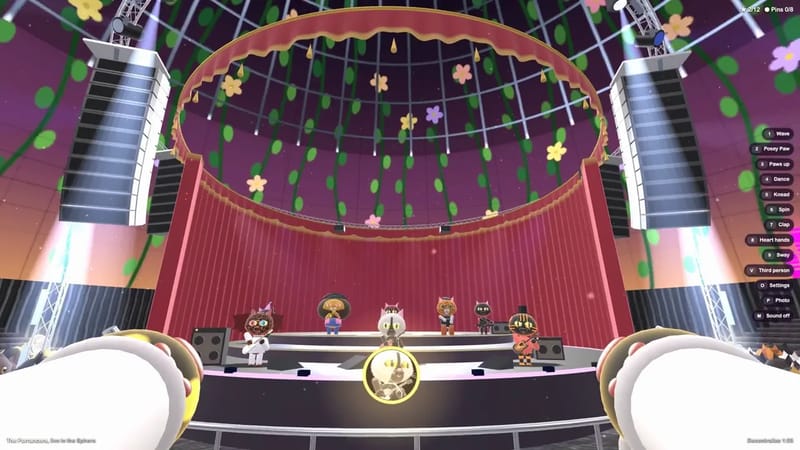
Vídeo de lanzamiento con peluches


 +7

@0kncnMotion graphics
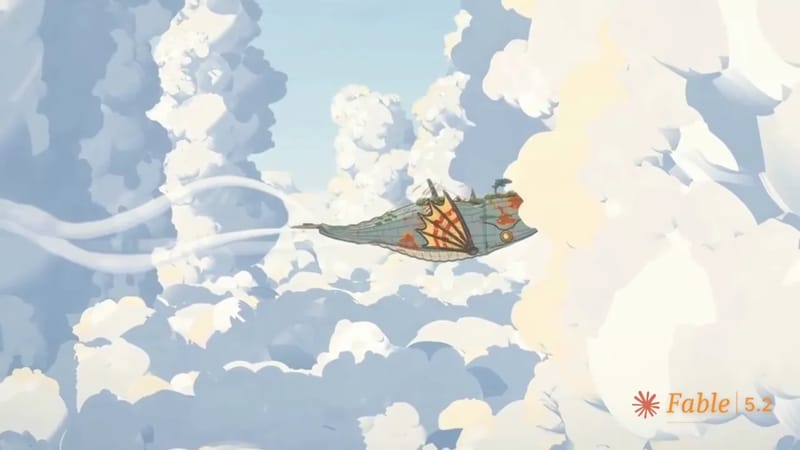
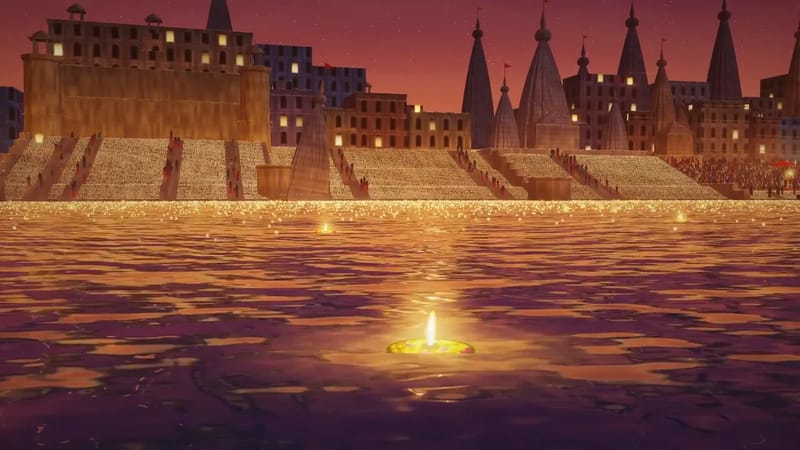
Fable 5.2 çıktı, ilk iş bunu denedim. Tek prompt yazdım, 90 saniyelik anime kısa film yaptı. Robota dönüşen bir buharlı lokomotif var. Blender'da her şeyi kendi kurdu, müziği de kendi yaptı. Prompt aşağıda 👇
— @0kncn
Create a 2D anime short. It must look completely like real Japanese anime, as if it were taken directly from a finished theatrical anime film. This is traditional-looking, hand-drawn 2D anime, not a 3D animation, a moving illustration, or a stylized web graphic.

Build everything in Blender from Python, render it in Eevee, then ink and paint every frame in a second pass. Deliver one 1920x1080, 24 fps MP4 with a synthesized soundtrack. Use any tools, libraries, references, guides, literally anything, as long as the final result looks 100% like hand-drawn 2D anime.

Use theatrical anime as the art style reference for the design, line work, painted backgrounds, color and atmosphere. The film is 90 seconds long (2160 frames), in 42 shots. Its hero is a steam locomotive that transforms into a robot. No people appear in the film.

HERO
No. 9, a 1940s 2-8-2 freight locomotive with a four-axle tender, 23 m long, asleep for decades in a mountain engine shed: matte black boiler with rust runs, faded red wheel centres and buffer beam, brass number plate "9", one large headlamp, two amber marker lamps, moss on the running boards, ivy through the cab windows, and a stork's nest on the cab roof. As a robot it stands 21 m tall with its shoulders at 17 m. It is an original design, not a character from any existing series. It moves on twos, slow and heavy. Its wheels never slip and its feet never slide.

TRANSFORM
One transformation, at full speed, 120 frames, in five stages of 24 frames. Every part is rigid: nothing stretches, nothing vanishes, nothing appears. Each part travels on a hinge or a slide you can see.
1. Legs: the tender uncouples, splits lengthwise and swings down; its two bogies lock as feet, the coal stays in bunkers on the calves.
2. Hips: the cab drops and widens into the pelvis; the trailing truck folds onto the lower back.
3. Torso: the boiler tilts upright, firebox at the waist, smokebox at the top; the chimney and steam dome end on the upper back and keep venting.
4. Arms: the running boards swing out with the cylinders as shoulders, the piston and connecting rods as forearms, and hands with three fingers and a thumb unfolding from the valve gear; the front driving wheels ride up as shoulder discs, the rear ones fold to hips and knees.
5. Head: the smokebox door hinges forward as the chest plate with the headlamp at its centre; a riveted helmet rises from the smokebox with one dark visor slit and the two marker lamps as amber eyes; the cowcatcher folds up as a collar.
The cab roof panel rides up to the right shoulder and carries the stork's nest, never tilted more than 10 degrees.
Stages 1-3 happen on the rails, with the first strides landing on the ballast either side of the track. Stages 4-5 happen in the air.

WORLD
A single-track mountain railway at real scale. At the top, an ore mine with a loading bunker and a rake of twelve four-wheel hopper wagons. The line descends through larch forest and a short rock tunnel to a viaduct: seven 18 m steel girder spans on stone piers, 126 m long, the deck 17 m above a turquoise meltwater river 3 m deep. Beyond it, a small station: a stone engine shed, a water tower, a semaphore signal with an alarm bell, a signal box, a siding ending in a sand drag. Snow peaks behind, a cliff face above the viaduct, telegraph poles along the whole line.

STORY
A clear spring morning in the valley. Meltwater loosens the cliff: a rockfall hits the middle pier of the viaduct, the pier collapses into the river and the two girders it carried sag into a V, held only by the rails. Up at the mine the shock snaps a coupling and the twelve loaded wagons start to roll downhill, unmanned. At the station the semaphore drops to danger and the bell rings. In the dark shed the firebox glows, the pressure needle climbs, the headlamp lights; the stork flies up. No. 9 bursts through the shed doors tearing ivy and rust, and charges up the grade with the wagons coming down the other side. On the approach it transforms at full speed, leaps from the abutment, lands crouched in the river, wades to the fallen pier, and lifts the sagging joint onto its shoulders and raised hands. The wagons hit the viaduct: it sinks 0.3 m as each one passes over and holds. The rake runs through the station into the sand drag and stops. No. 9 does not come back out. It locks its knees and stays as the new pier. The steam thins, the stork returns to its nest, the visor dims.

LIGHT
High-key anime light, never murky: a morning sun from the south-east, a saturated cobalt sky, white cumulus with lavender shadows, snow peaks with blue shadows, fresh green larch, a turquoise river with drawn white water. Light only changes with a cause you can see: rock dust dims the gorge for 3 seconds, steam whites out a frame, the firebox throws orange onto the shed walls. Cel light with hard shadows, gouache backgrounds, ink lines on every machine, rail and building, effects drawn on twos: steam as inked rolling shapes with a flat shadow tone, water as inked sheets with foam crowns, dust as drawn clouds, never particle mush.

SOUND
A synthesized orchestra on a 144 bpm grid: one beat is 10 frames, and every cut lands on a multiple of 5 frames. A hopeful theme on clarinet and horn, the collapse in E minor, a 12/8 chase with the exhaust chuff as percussion at four beats per wheel revolution, a heavy 3/4 for the hold with one low drum per wagon. 16 hits land exactly on the picture: the rockfall, the pier, the coupling, the signal arm, the shed doors, each transformation lock, the landing, the lift, the first and last wagon. The steam whistle is heard twice: once on waking, once on the hold.

FORMAT
Write the film as a Python story clock: one state per frame for every pose, camera, wheel angle, rod position, transformation part, wagon, effect and sound cue.

CHECKS
Before the final render a script tests every frame on the real meshes: no part of No. 9 goes through another part, in either form or at any frame of the transformation; the total volume of its parts is the same in both forms; every wheel on a rail turns exactly as far as it travels; planted feet do not move; No. 9 never goes through the track, the shed, the viaduct or the riverbed; the wagons stay on the rails and never touch each other except at the couplings; the camera never enters a mesh, the cliff or the water; nothing jumps between frames.
 Motion graphicsNuevo1:45