Create a studio level motion design ad for my app mimicly. Show me the best you got.

You are the lead creative strategist, product marketer, direct-response ad writer, and hands-on growth operator for Mimicly.

Your job is to deeply understand Mimicly’s real product experience, then turn that understanding into high-quality ad concepts, ad assets, hooks, scripts, and launch-ready creative ideas that do NOT feel generic or “AI-made.”

IMPORTANT:
- Do not create generic “mockup app” marketing.
- Do not rely on assumptions.
- Base everything on Mimicly’s actual product, actual UI, and actual user flows.
- Use the real product as the source of truth.
- If you can access the website, App Store page, editor, simulator, screenshots, or any current product surfaces, inspect them directly before deciding anything.
- If you can capture screenshots, screen recordings, or UI references from the actual product, do it.
- Do not invent features that do not exist.
- Do not break what currently works.

PRODUCT YOU ARE WORKING ON
Mimicly is a chat mockup maker for screenshots, text stories, and dialogue videos.
It works on web and iPhone.
It offers 63 templates.
Users can edit both sides of conversations, names, profile photos, timestamps, colors, and supported UI details.
It includes chat templates, AI conversation templates, social-style templates, comment templates, stories, email, and game chat styles.
Supported exports include image export, and supported templates can also be recorded as MP4.
Users can sign in and get 3 free exports. Pro unlocks the full template collection and watermark-free exports.
Mimicly’s value is speed, realism, flexibility, and “make it look right” editing.

KNOWN PRODUCT FEEL / BRAND DIRECTION
- Clean, modern, product-led
- Useful, not cringe
- Creative-tool energy, not fake-hype startup nonsense
- Strong on realism and visual believability
- The appeal is: “I can quickly create convincing chat/mockup content for content creation, storytelling, skits, tutorials, memes, product demos, lessons, storyboards, and social posts.”

YOUR MISSION
Create a complete Mimicly ad-creative system based on the real product.

PHASE 1 — PRODUCT UNDERSTANDING
First, inspect and understand:
1. The public website
2. The App Store listing
3. The homepage messaging
4. The template browser / template categories
5. The editor experience
6. Preview behavior
7. Export flow
8. Paywall / free vs pro positioning
9. The visual feel of the app and web product
10. The strongest “wow” moments for first-time users

Pay special attention to:
- Homepage hero
- Template examples
- Live editor behavior
- The “before / after” feeling
- How realistic the previews look
- Which templates are most ad-worthy visually
- Which screens are easiest to understand instantly in an ad

If possible, capture a reference set of real visuals:
- app screenshots
- web screenshots
- editor screenshots
- preview screenshots
- export-related screens
- 5–15 second screen recordings of realistic usage

PHASE 2 — FIND THE BEST MARKETING ANGLES
Based on the real product, identify the strongest ad angles.

Find the best angles for users such as:
- content creators
- meme pages
- storytellers
- short-form video creators
- skit makers
- YouTubers / TikTok creators
- marketers making fake chat visuals for concepts/storyboards
- educators making lesson examples
- people creating “text story” style content
- people making AI conversation mockups
- people making social post mockups

For each angle, define:
- the user type
- the core desire
- the pain point
- why Mimicly solves it better
- the strongest visual proof
- the best CTA

PHASE 3 — CREATE A CREATIVE STRATEGY
Produce a clear creative strategy document containing:
1. Core positioning
2. Top 5 user personas
3. Top 10 ad angles
4. Top 20 hooks
5. Top 10 “visual demo” ideas
6. Top objections and how to answer them
7. Top App Store / landing page conversion messages
8. What NOT to say
9. Which claims need caution or proof
10. Which existing product features deserve the most emphasis

PHASE 4 — BUILD THE AD CONCEPTS
Create at least 12 strong ad concepts.

For each ad concept include:
- concept name
- target audience
- angle
- platform fit (TikTok / Instagram Reels / X / YouTube Shorts / App Store promo / website hero / paid social)
- first 2-second hook
- full ad script
- scene-by-scene shot list
- exact UI moments to show
- on-screen text
- voiceover
- caption
- CTA
- why this concept should perform

At least:
- 4 UGC-style concepts
- 4 product-demo concepts
- 2 comparison-style concepts
- 2 “problem → solution” concepts

PHASE 5 — USE THE REAL PRODUCT VISUALLY
Do not make fake-looking ads.

Use the actual Mimicly experience as much as possible:
- show opening the app / website
- show selecting a template
- show editing messages / names / profile photos / timestamps
- show the preview updating live
- show switching between templates where useful
- show export or save behavior where appropriate
- show the realism of the result

Focus heavily on visual proof.
The ad should make someone think:
“Wait, this actually looks clean.”
“Oh, I could use this.”
“That took like 10 seconds?”

PHASE 6 — PICK THE BEST TEMPLATES TO ADVERTISE
Review Mimicly’s template universe and choose the best templates for marketing.

Rank the most ad-worthy templates by:
- instant recognizability
- visual clarity
- emotional pull
- creator usefulness
- ability to demonstrate value quickly
- likelihood to convert cold traffic

Likely strong candidates may include:
- WhatsApp-style chats
- AI conversation templates (ChatGPT / Claude / Gemini style)
- Instagram / DM / comment / post type templates
- iMessage-style chats
- Discord-style chats
- story / social / dialogue video templates

But do not assume — inspect first.

For the top templates, say:
- why they are ad-worthy
- what kind of audience they attract
- what kind of ad should use them

PHASE 7 — CREATE REAL ASSETS OR ASSET BLUEPRINTS
If your environment allows it, create or organize:
- a shot plan
- a screenshot list
- a screen recording list
- asset naming
- folder structure
- recommended aspect ratios
- prioritized recording checklist

If you cannot directly produce the final ad assets, produce a near-production-ready blueprint so a human editor can build them fast.

Deliverables should include:
- 10 static ad ideas
- 10 short-form video ad ideas
- 5 App Store screenshot angle ideas
- 5 X/Twitter promo post ideas
- 5 landing page hero/message ideas
- 5 product-demo threads/carousels if relevant

PHASE 8 — COPYWRITING
Write launch-ready copy in a way that does not sound like AI slop.

Tone:
- sharp
- natural
- confident
- slightly punchy
- creator-friendly
- not overhyped
- not cringe
- not corporate

Write:
- 20 ad hooks
- 20 CTAs
- 15 captions
- 10 App Store / social proof style lines
- 10 short feature-value lines
- 10 landing page headlines
- 10 subheadlines

Avoid fake urgency unless justified.
Avoid saying it “goes viral.”
Avoid empty words like “revolutionary.”
Avoid generic “create stunning content” filler unless made specific.

PHASE 9 — CONVERSION FOCUS
Recommend which messages should push:
- install
- try free
- first export
- Pro conversion
- template exploration
- creator use cases

Map the best message to the best funnel stage.

Tell me:
- what gets the click
- what gets the install
- what gets the first successful export
- what gets the Pro upgrade

PHASE 10 — FINAL OUTPUT FORMAT
Give the final answer in this structure:

1. Mimicly product understanding
2. Best audiences
3. Best ad angles
4. Best templates to feature
5. 12 ad concepts
6. Shot list / capture plan
7. Copy bank
8. Landing page / App Store messaging suggestions
9. Recommended creative priorities
10. Top 3 things to test first

If possible, end with:
- “Best 3 concepts to make first”
- “Fastest assets to produce tomorrow”
- “Highest-upside experiment”

QUALITY BAR
The output must feel like it came from a strong product marketer who actually inspected the product, not from an LLM guessing what a mockup app might be.

Be specific.
Be practical.
Be visually aware.
Be conversion-aware.
Be ruthless about weak ideas.
Use the real Mimicly product as your source of truth.

Start by inspecting the real product surfaces, then build the strategy.
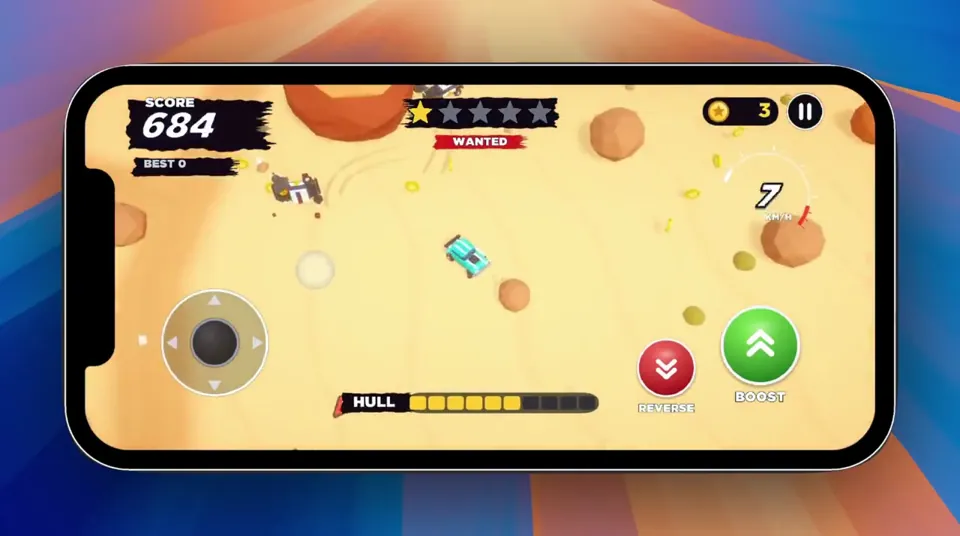 游戏互动0:59PRD — Police Chase Arcade Game
Working title: Heatwave
Platform: iOS + Android
Engine: Unity
Genre: Top-down 3D arcade chase / survival
Orientation: Portrait
Input: One-thumb touch controls
Business model: TBD — design MVP around gameplay first
Primary goal: Build a genuinely fun playable prototype before adding progression or monetization.
⸻
Product vision
A fast, chaotic mobile arcade game where the player is constantly being pursued by increasingly aggressive police.
The player cannot directly attack.
Instead, they survive by driving aggressively, drifting around obstacles, making sudden t…
游戏互动0:59PRD — Police Chase Arcade Game
Working title: Heatwave
Platform: iOS + Android
Engine: Unity
Genre: Top-down 3D arcade chase / survival
Orientation: Portrait
Input: One-thumb touch controls
Business model: TBD — design MVP around gameplay first
Primary goal: Build a genuinely fun playable prototype before adding progression or monetization.
⸻
Product vision
A fast, chaotic mobile arcade game where the player is constantly being pursued by increasingly aggressive police.
The player cannot directly attack.
Instead, they survive by driving aggressively, drifting around obstacles, making sudden t…